Thursday, 30 May 2013

The Dignity of Rasulullah (Sallallaahu 'alayhi wasallam)


Bismihi Ta’ala

Hazrat Ayesha (RA) reported that : “It was not the nature of Rasulullah (SallAllaahu ‘alayhi wasallam) to talk indecently, nor did he engage himself in the use of obscene language. Nor did he shout and talk in the bazaars (which is against dignity). He did not avenge a bad deed with a bad one, but forgave it, and thereafter did not even mention it.”  
COMMENTARY
§    Some people are by nature, indecent and habituated to telling obscene jokes; some, in order to keep a gathering happy, indulge in indecent conversations. For this reason, Hazrat Ayesha (RA) refuted both.

There is no harm if one goes to the bazaar to fulfil one’s needs, but to go there and shout about is against dignity. One should, in a quiet manner, complete one’s needs and return. This also does not mean that by not shouting in the bazaar, he made a noise at other places. The object is that it is generally found that people make a noise in the bazaars (whilst dealing, etc.). If one is calm in the bazaars, it is apparent that at other places too, one will be calm.

§     The whole history of Rasulullah (SallAllaahu ‘alayhi wasallam) is filled with incidents where he did not avenge a bad deed with a bad one. What type of torments and suffering did he not suffer at the hands of the non-believers? What did he not confront in the Battle of Uhud? When the Sahaba (RA) could not bear these happenings, they requested Rasulullah (SallAllaahu ‘alayhi wasallam) to curse these non-believers. Instead Rasulullah (SallAllaahu ‘alayhi wasallam) made this Dua : “O Allah, grant my nation Hidayah, for they know not.”


 [Extracted from Shamaa`il Tirmizi]


Thursday, 23 May 2013

Following the Jews and Christians


Bismihi Ta'ala

Rasulullah (Sallallaahu ‘alayhi wasallam) said: “You will certainly follow the actions of those before you in everything (inch by inch) to the extent that if they entered the hole of a lizard, you will follow them”.

The Sahabah (Radhiyallaahu ‘anhum) asked: “O Rasul of Allah (Sallallaahu ‘alayhi wasallam), are you referring to the Jews and the Christians?”

Rasulullah (Sallallaahu ‘alayhi wasallam) replied: “Then who else?”

[Sahih Bukhari]

Sunday, 19 May 2013

Sunnats and Duas Upon Entering And Leaving The Toilet


Bismihi Ta'ala

1.)           For the purpose of  Istinja, take along water and lumps of clay. To use three lumps of clay or three stones is Mustahab (preferable). If circumstances prevail, then this will be sufficient.

Due to (clay lumps), difficulties are experienced in flushing the toilets. Thus, the Ulama have advised that toilet tissue should be used so that the flush is not spoilt.

2.)         It was the practice of Rasulullah (Sallallaahu ‘alayhi wasallam) to visit the toilet with his head covered and with his shoes on.
[Alaikum besunnati]

3.)              Before entering the toilet recite this Dua:


Note: Mullah Ali Qari (Rahmatullahi ‘alayh) has written in Mirqaat that with the blessings of the recitation of this Dua, a veil is cast between the person visiting the toilet and the evil Jinns. Hence they are unable to see one’s private parts. 
He has also written that the (ب) of the word
can be read with either a dhamma (Pesh) or a Saakin (Jazm).
[Mirqaat - Vol. 1, pg. 361]

4.)              When entering the toilet, enter with the left foot.
[Alaikum besunnati quoting from Ibn Majah]

5.)          When removing the undergarment, it is better to lower oneself towards the ground as much as easily possible and thereafter remove the garment.
[Tirmidhi, Abu Dawood]

6.)              When coming out from the toilet, step out with the right foot first and then recite this Dua:


7.)           Before entering the toilet, remove any ring etc. upon which any Ayat or the name of Rasulullah (Sallallaahu ‘alayhi wasallam) is visible.
[Nasai]

If a Ta’weez is covered with a cloth and sewn, it will be permissible to enter the toilet while wearing it.

8.)              When relieving oneself, do not face the Qibla nor turn the back towards it.
[Mishkaat , Tirmidhi , Ibn Majah]

9.)             When relieving oneself, do not speak except out of absolute necessity. Also, do not engage in any Zikr whilst in the toilet.

[Mishkaat, Abu Dawood - pg. 3]

10.)         Be extremely careful and ensure that droplets of urine and stool do not splash upon one as most of the punishment of the grave is due to not protecting oneself from urine splashes.
[Bukhari, Ibn Maajah]

11.)      Do not touch the private parts with the right hand during Istinjaa. Use the left hand for this purpose.
[Bukhari, Abu Dawood]

12.)         Where a toilet is not available, relieve oneself behind some barrier so that one is not exposed to others.
[Abu Dawood, Ibn Majah]

13.)        Search for soft ground (when relieving oneself in the open) so that urine does not splash but is rather absorbed into the ground.
[Tirmidhi, Abu Dawood]

14.)         Sit and urinate. Do not urinate while standing.
[Tirmidhi]

15.)         After urinating, if one needs to dry himself he should do so behind some barrier (i.e. wall etc.)
[Behishti Zewar]

16.)         Perform Wudhu according to the Sunnat at home.

17.)         Perform the Sunnats  at home before going to the  Masjid.  If there is no time for this, the same could be performed in the Masjid.

Note: In today’s times, due to Sunnats being neglected, it is preferable to perform them in the Masjid.
[Kamaalate Ashrafiya]


From "BEAUTIFUL SUNNATS OF THE BELOVED 
NABI (SALLALLAAHU 'ALAYHI WASALLAM) 
By Hadhrat Moulana Shah Hakeem Muhammad Akhtar Saheb 
(Daamat Barakaatuhum)

Download the book here


Thursday, 9 May 2013

The Goodness and Benefits of a Muslim


Bismihi Ta'ala


Imam Bukhari and Imam Muslim narrate on the authority of Hazrat 'Abdullah Ibn Umar (RA) who said :


"We were sitting in the company of Rasulullah (Sallallaahu ‘alayhi wasallam)  when a palm core (an edible tuber growing at the upper end of the palm trunk) was brought to him. While eating it, he said: 'From among the many trees, there is a green tree. Its goodness and benefits are like that of a Muslim. Its leaves do not fall, nor do they scatter about. It produces its fruit at its appropriate time by the permission of its Sustainer. It is similar to a Muslim. Tell me, what tree is it?'


Hazrat Abdullah says : ‘The people began thinking about the different trees in the forests. Some of them said : It is such and such tree. It occurred to me that it is the date-palm. I wanted to say this [to Rasulullah (Sallallaahu ‘alayhi wasallam)] but became scared to utter anything. When I looked at myself, I saw myself merely ten years old – the youngest and smallest of all who were present. When I looked around me, I saw Abu Bakr and ‘Umar sitting silently. So I also remained silent.’


‘When these two [Abu Bakr and ‘Umar] did not speak, all the people said : You tell us what tree it is O Rasulullah!


Rasulullah (Sallallaahu ‘alayhi wasallam) said: ‘It is the date-palm.’


When we got up from there, I said to my father, ‘Umar : ‘O my father! I take an oath by Allah that it had occurred to me that it was the date-palm.’


He said: ‘What prevented you from giving the answer?’


I said : ‘I saw all of you remaining silent. I saw that you and Abu Bakr too were not speaking. And I am a young boy. I therefore felt shy and did not want to speak or say anything. I therefore remained silent.’


Hazrat ‘Umar said : ‘Had you given the answer, it would have been far more beloved to me than my having such and such thing.’


There are several reasons for comparing the date palm to a Muslim:

  • It is considered to be the noblest of trees and the highest in rank.
  • There is abundant goodness in it.
  • It provides shade all the time.
  • It produces wholesome fruit.
  • It is found all the time.
  • From the time its fruit appears, it is eaten in different forms till new dates appear and they are also harvested.
  •  When the date palm dries, numerous benefits are taken from it.
  • Its wood, leaves and branches are used for stumps, firewood, staffs, batons, rope, utensils, etc.
  • The last thing used thereof are its date-pits. They are used as fodder for camels.


As for the beauty of its growth and leaves, its beautiful shape and fruit, its lofty and soaring height, its evergreen leaves, its firm roots which prevent the winds and storms from uprooting it, its noble shadow and shade - in all this are obvious benefits and numerous well-known and praiseworthy advantages for those who are living the Arabian Peninsula.

Allah Ta'ala has praised this tree greatly in several verses in the Qur`aan Sharief.


In a like manner is the Muslim or the Believer :

  • He is an embodiment of goodness and benefit.
  • His blessings are wide-ranging in all situations.
  • His benefits are continual in his favour and in favour of others even after his death.
  • He is one who does good deeds, speaks good, engages in various types of obedience; be they fasting, offering Salaah, reciting the Qur`aan Sharief, remembering Allah Ta'ala, reminding others of Allah Ta'ala, giving in charity, commanding good and prohibiting evil.


  • He intermingles with people; he exercises patience over their transgressions against him.
  • He is loving and attracts people towards him.
  • He benefits people without causing them any harm.
  • He is beautiful in his conduct and in his speech.
  • His noble qualities are spent for the benefit of people.
  • He gives and does not refuse.
  • He gives preference to others and is not covetous.
  • The passage of days only increases him in his aloofness and detachment from this world.
  • Hardships and afflictions only serve to make him firm and steadfast on the truth, more lofty towards goodness and benefit, and further away from decline.


  • His deeds are accepted and liked by his Sustainer.
  • If you sit in his company, he will benefit you.
  • If you become a partner with him, he will benefit you.
  • If you accompany him, he will benefit you.
  • If you ask his advice, he will benefit you.
  • There is benefit in every state of his affairs.
  • Whatever knowledge emanates from him is a source of nourishment for the souls and hearts.
  • He is covered and encompassed by his religion.
  • He does not become devoid of the clothing of piety.
  • His deeds do not stop whether he is in a state of affluence or poverty, health or illness.

  In fact, his deeds do not stop even after his death.
  • He looks at his life for his hereafter. He takes benefit from today for his tomorrow.
  • Benefit is derived from everything that he does; be he alive or dead.

…The reason for this is that the basis of all his deeds and activities is belief in Allah Ta’ala and benefiting the servants of Allah. Glory be to Allah! How great a Believer is!

Extracted from the English Translation of  PROPHET MUHAMMAD (Sallallaahu 'alayhi wasallam): 
THE TEACHER AND HIS TEACHING METHODOLOGIES 
Shaykh Abdul Fattah Abu Ghuddah (RA)


Saturday, 13 April 2013

The Last 3 Verses of Surah Hashr


Bismihi Ta’ala


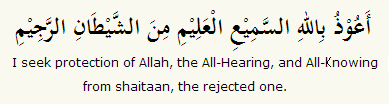
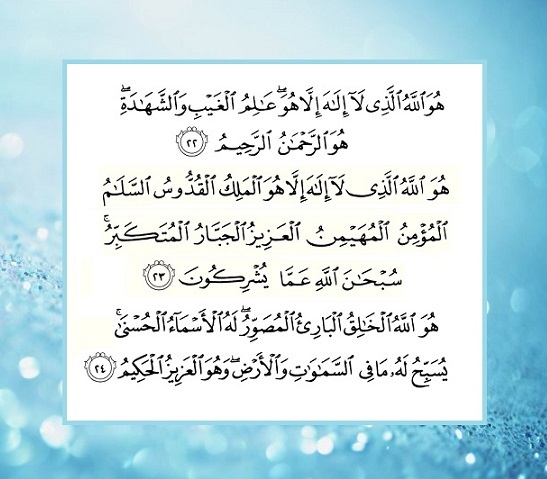
It has been narrated by Hadhrat Ma’qal Ibn Yasaar that Rasulullah (SallAllaahu 'alaihi wasallam) said that one who recites thrice in the morning:


followed by the last three verses of Surah Hashr once, Allah Ta’ala will appoint over him 70,000 angels who will beg for forgiveness on his behalf until nightfall, and if he happens to die during the course of the day, he will die as a martyr. 
And whoever recites this at night, he will attain the same reward. 
(Mishkaat)


Extracted from Morning and Evening Duas 
By: Shaykh ul Arab wal Ajam Hazrat Maulana Shah Hakeem Muhammad Akhtar Saheb (DB)

Download here


Tuesday, 9 April 2013

Sunnats upon Awakening


Bismihi Ta'ala

1.   Immediately upon awakening rub the face and the eyes with both palms in order to remove the effects of sleep.
[Shamaa`il Tirmidhi]

2.     When the eyes open in the morning recite the Dua:


3.     When awakening from sleep, clean the mouth with a Miswaak.

[Musnad Ahmad, Abu Dawood]


The use of the Miswaak should be repeated when making Wudhu. Using Miswaak upon awakening is a separate Sunnah.

4.    When wearing one’s trousers, first put on the right leg, then the left one. When putting on a Kurta or shirt, first put on the right sleeve and then the left one. The same procedure should be followed when wearing a vest. When wearing a shoe, first put on the right shoe. When removing any garment or shoe, first remove the left, then the right. This is the Sunnah method when removing any garment from the body.

[Bukhari – Tirmidhi]

5.     Before immersing the hands into any utensils, wash them thrice thoroughly.
[Tirmidhi]

From "BEAUTIFUL SUNNATS OF THE BELOVED 
NABI (SALLALLAAHU 'ALAYHI WASALLAM) 
By Hadhrat Moulana Shah Hakeem Muhammad Akhtar Saheb 
(Daamat Barakaatuhum)

Download the book here


Saturday, 6 April 2013

Book | Ash-Shamaa`il al-Kubra


Bismihi Ta'ala 


"This compilation is an indisputable collection of the lofty mannerisms, traits and conduct of our beloved Prophet (peace and blessings upon him), which has been compiled from many reliable books of Hadeeth and Seerah (prophetic biographies).

The book is a priceless treasure for the 'seeker of the Sunnah' and one who is in love with the perfect lifestyle of Rasulullah (SallAllaahu 'alayhi wasallam).

 The sublime Sunnah of Rasulullah (SallAllaahu ‘alayhi wasallam) is sufficient for 
the needs of all genuine seekers of the truth.
Mufti Muhammad Irshad Qasmi authored the original work 
(Ash-Shamaa'il al-Kubra) in the Urdu language.

This English translation is by Abdur-Rahman ibn Hafiz Hussein Kolia, student of Hazrat Maulana Fadhl ar-Rahman A'zami (Sheikh al-Hadeeth of Darul Uloom, Azaadville)."